Key insights about Proliferation Financing of Weapons of Mass Destruction
1. Introduction
Proliferation of weapons of mass destruction is very dangerous to the security and safety of global community as those weapons which include mainly nuclear, chemical and biological can be used to kill or eliminate a big number of people in a very short period of time. Not only countries may want to possess those weapons to commit attacks but also terrorists.
Proliferation of weapons does not only involve the production or development or purchase of these weapons and their means of delivery but also buying or obtaining the materials/goods and the knowledge required for weapons development/production.
Proliferation requires funds; Proliferators need money and goods to support their activities hence the financing of proliferation is a serious concern that has raised international attention. National, regional and international measures have been put in place to fight against the financing of weapons of mass destruction.
United Nations Security Council (UNSCR) adopted resolutions 1718, 1874, 2087, 2094, 2231, 2270, 2321, 2356, and 2397. In relation to the fighting against proliferation financing, Financial Action Task Force (FATF) has developed specific requirements to implement the aforementioned resolutions of UNSCR.
With recommendation 7, countries are required to implement targeted financial sanctions to comply with UNSCRs relating to the prevention, suppression, and disruption of proliferation of weapons of mass destruction and its financing.
With this recommendation, countries are required to take preventive measures that are necessary to stop the flows of funds or other assets to proliferators or proliferation and the use of funds or other assets by proliferators or proliferation.
This paper aims at increasing the understanding by individuals and institutions on proliferation financing issues.
2. What is proliferation financing of weapons of mass destruction?
FATF defines proliferation financing to be an act of providing funds or financial services which are used, in whole or in part, for the manufacture, acquisition, possession, development, export, trans-shipment, brokering, transport, transfer, stockpiling or use of nuclear, chemical or biological weapons and their means of delivery and related materials (including both technologies and dual use goods used for non-legitimate purposes), in contravention of national laws or, where applicable, international obligations.
It also includes providing technical training, property or funds, financial service, advice, service, brokering or assistance related to any of the activities aforementioned.
The Rwanda Law nº 028/2023 of 19/05/2023 has defined proliferation financing in the same line with FATF.
3. Who can commit proliferation financing and how?
Both individuals and states can engage in proliferation financing through providing the financial support for development, acquisition, or spread of weapons of mass destruction (WMDs) and their means of delivery. They use different measures to raise and/or move funds, some of which are the following:
- Illicit Trade and Smuggling: Individuals or entities engage in illegal trade and smuggling to procure components, materials, or technologies necessary for WMD production.
- Front Companies and Financial Institutions: Front companies and financial institutions may be established to act as intermediaries in financial transactions related to WMD proliferation in facilitating the movement of funds while concealing the involvement of the ultimate beneficiaries.
- Crypto-Currencies and Digital Financing: Proliferators may exploit digital currencies or other financial technologies to move funds discreetly and anonymously, making it challenging for authorities to trace and monitor transactions related to WMD development.
- Foreign Investments and Joint Ventures: States or entities may invest in foreign companies or establish joint ventures to gain access to technologies and expertise related to WMD development
4. What are the stages of proliferation financing?
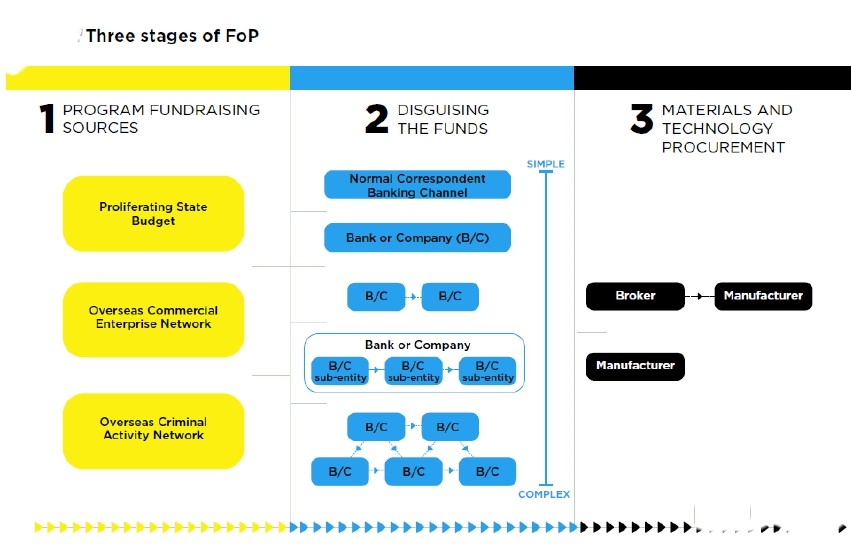
Proliferation financing is done through three stages mentioned below:
a) Program fundraising: A proliferating country or individual raises financial resources for in country costs. The funding sources may derive from the proliferating country’s budget, profits from an overseas commercial enterprise network, and/or proceeds from an overseas criminal activity network. For example, the UN Panel of Experts has found that North Korea/DPRK has exported prohibited commodities (such as coal, iron and steel products, and copper) to generate revenue. International observers believe that the DPRK’s sales of natural resources are part of elaborate trade-based payment schemes to support its WMD and conventional weapons program development.
b) Disguising the funds: The proliferating state/individual moves assets into the international financial system, often involving a foreign exchange transaction, for trade purposes. She/he may use means that range from the simpler to the more complex, including using normal correspondent banking channels or an intricate network of procurement agents and front companies. During this stage, states that are subject to comprehensive sanctions will seek to circumvent such sanctions, often using methods on the more sophisticated end of the spectrum to disguise the funds. Both Iran and the DPRK have been found to use front companies, shell companies, and complex, opaque ownership structures to evade and circumvent Terrorism Financing sanctions.
c) Procurement of proliferation-sensitive materials and technology: The proliferating state or its agents or individual use the disguised resources for procurement of materials and technology within the international financial system. This stage also includes the payments for shipping and transport of materials and technology. A past UN Panel of Experts report observed that Iran used various procurement methods, including using front companies for prohibited procurement, as well as using its petrochemical sector to obscure the end use of items procured for its nuclear program.
5. Key indicators of Proliferation Financing
Identifying proliferation financing involves recognizing specific indicators that may suggest the involvement of individuals, entities, or states in activities supporting the development, acquisition, or spread of weapons of mass destruction (WMDs) and their means of delivery. These indicators can be complex and interconnected, but they provide valuable insights for authorities to investigate potential cases. Some of these indicators include the following:
- The customer is vague and resistant to providing additional information when asked;
- The customer’s activity does not match its business profile or the end-user information does not match the end-user’s business profile;
- The transaction involves designated persons;
- The transaction involves higher risk jurisdictions which are known to be involved in proliferation of weapons of mass destruction or proliferation financing activities;
- The transaction involves other financial institutions with known deficiencies in AML/CFT controls or controls for combating proliferation financing;
- The transaction involves possible shell companies (e.g. companies that do not have a high level of capitalisation or display other shell company indicators);
- The transaction involves containers whose numbers have been changed or ships that have been renamed;
- The shipment of goods takes a circuitous route or the financial transaction is structured in a circuitous manner;
- The transaction involves the shipment of goods inconsistent with normal geographic trade patterns (e.g. the country involved would not normally export or import such goods);
- The transaction involves the shipment of goods incompatible with the technical level of the country to which goods are being shipped (e.g. semiconductor manufacturing equipment shipped to a country with no electronics industry); or
- There are inconsistencies in the information provided in trade documents and financial flows (e.g. in the names, companies, addresses, ports of call and final destination);
- Transaction involves persons or companies located in countries with weak export controls.
6. Measures to prevent proliferation financing
AML/CFT measures refer to a set of regulations, procedures, and best practices that are designed to prevent the crimes of money laundering, terrorist financing as well as proliferation financing.
These measures typically include:
-
Customer Due Diligence (CDD): Financial institutions and other reporting persons are required to identify and verify the identity of their customers and understand the nature of their business and financial transactions. This includes conducting background checks on customers, assessing their risk profile, and monitoring their transactions for suspicious activity. For high-risk customers enhanced measures shall be applied. They have also to screen the clients against the PF list.
- Transaction monitoring: Financial institutions and other reporting persons are required to monitor their customers' transactions and report any suspicious activity to the relevant authorities. For high risk transactions, enhanced scrutiny is applied.
- Record-keeping: Financial institutions and other reporting persons are required to maintain records of their customers' transactions and activities for a certain period of time. This includes details of the customer's identity, the nature of the transaction, and the source and destination of the funds.
- Risk assessments: Financial institutions and other reporting persons are required to conduct periodic risk assessments to identify and mitigate the risks of money laundering and terrorist financing. This involves analyzing their customer base, the products and services they offer, and the countries and regions they operate in.
- Preventive measures: Financial institutions and other reporting persons are required to put in place the preventive measures to prevent the provision of financial services for the development of weapons of mass destruction.
- Training and awareness: Financial institutions and other reporting persons are required to provide their staff with training and awareness programs on PF regulations and best practices.
- Implementation of targeted financial sanctions to prevent any proliferator from raising, moving and using funds: The application of these sanctions is very effective in disrupting weapons of mass destruction proliferation networks.
- Applying efficient export controls to detect the proliferation sensitive goods.
7. Targeted Financial Sanctions related to proliferation financing
Among the 40 FATF recommendations, recommendation 7 requires countries to implement targeted financial sanctions to comply with United Nations Security Council resolutions relating to the prevention, suppression and disruption of proliferation of weapons of mass destruction and its financing. These resolutions require countries to freeze without delay the funds or other assets of, and to ensure that no funds and other assets are made available, directly or indirectly, to or for the benefit of, any person or entity designated by, or under the authority of, the United Nations Security Council under Chapter VII of the Charter of the United Nations, pursuant to Security Council resolutions that relate to the prevention and disruption of the financing of proliferation of weapons of mass destruction.
8. Punishment of proliferation financing in Rwanda
Article 56 of the Law nº 028/2023 of 19/05/2023 states that a person who carries out one of the acts of financing of proliferation of weapons of mass destruction, commits an offence. Upon conviction, he or she is liable to imprisonment for a term of not less than 20 years but not more than 25 years and a fine of 5 to 10 times the value of the financing given.
The penalties referred to above paragraph apply to a person who knowingly makes an agreement or has interest in it in order to acquire property or funds or enables another person to acquire money or support, knowing or having serious grounds to suspect that they may be used for financing of proliferation of weapons of mass destruction.
9. Penalties against a legal entity
Article 60 of the Law nº 028/2023 of 19/05/2023 states that a legal entity that carries out financing of proliferation of weapons of mass destructions acts through their representatives or members, commits an offence. Upon conviction, that legal entity is liable to a fine of Rwandan francs of ten (10) to twenty (20) times the amount of money laundered or given, without prejudice to the liability for complicity of its representatives.
No single country or organization can effectively combat Proliferation financing alone. Therefore, international cooperation and collaboration are essential to disrupt the financial networks of terrorist groups or of proliferators and prevent them from accessing the resources they need to carry out their financing proliferation activities.